
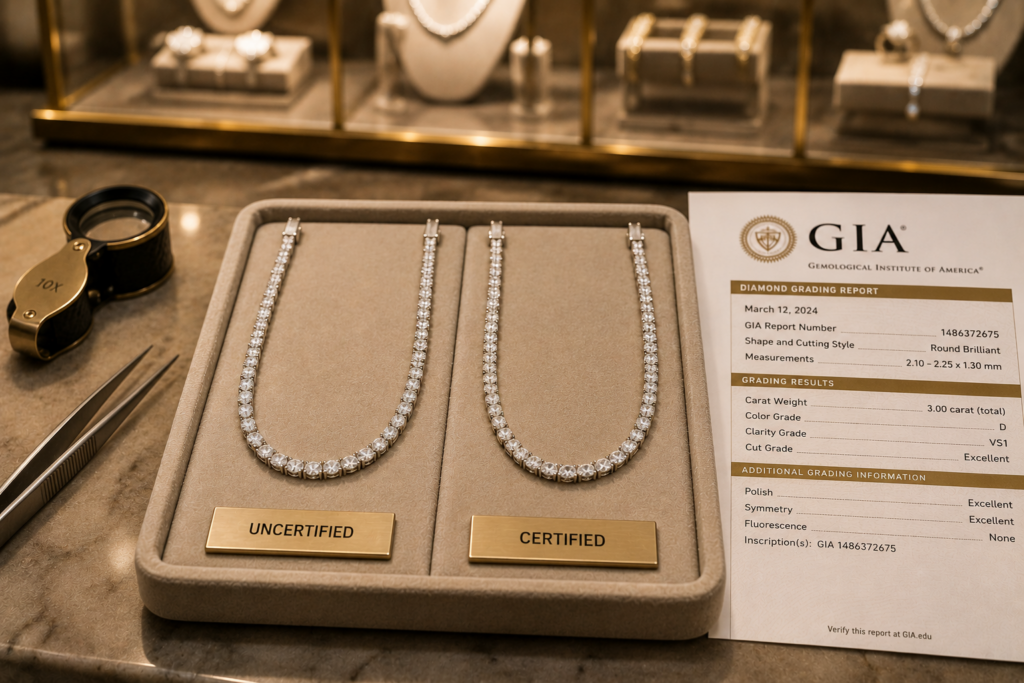
You’re in a jewellery store looking at two diamonds that, to your eye, look almost identical. Same sparkle, similar size, same immediate emotional reaction. But one of them is noticeably more expensive.
The reason is not visible in the stone itself. It sits behind it. A certificate.
That certificate is usually from institutions like GIA, HRD, or IGI, which grade diamonds using the 4Cs: cut, colour, clarity, carat, and more. On the surface, it feels like a system designed to remove uncertainty. But the reality is that it doesn’t remove uncertainty, but organises it.
Consider a smaller diamond: a 0.10 carat stone, VS1 clarity, G colour. In the real market, you might see a $200 per carat difference! The stone itself can be visually indistinguishable to most buyers. The difference is not what you see, but what accompanies it. The certificate becomes part of the product. And that addition changes how the market values it.
This is where things become interesting, because the pricing gap is not purely about physical quality. It is about perceived certainty and resale confidence.
Uncertified diamonds are often misunderstood as lower or unknown quality. In reality, many are assessed by experienced traders who have spent decades grading stones visually and comparing them across thousands of examples. They can identify clarity ranges, colour tones, and cut quality without needing a formal report. The diamond is still understood. It is just not translated into institutional language. And because it lacks that institutional translation, it typically enters the market at a lower price point.
Is the discount reflecting lower quality, or lower trust in documentation?
Even certified diamonds are not as objective as they appear. At the boundaries of grading categories, interpretation still plays a role. A diamond can sit between two clarity grades or two colour grades, and its final classification depends on where evaluators place it. This doesn’t imply fraud or manipulation in most cases. It reflects the reality of any system that converts continuous variation into fixed categories.
So the real comparison is not between truth and guesswork. It is between two forms of judgement. On one side, institutional grading systems that create consistency across markets. On the other, individual expertise, where experienced traders rely on direct visual assessment and market knowledge.
When you choose a certified diamond, you are not only buying the stone. You are also buying a layer of external validation, something that allows you to justify the purchase in a universally recognised way. When you choose an uncertified diamond, you are placing more weight on your own trust in the jeweller or trader, and less on institutional confirmation.
The difference is not just financial. It is psychological.
You are choosing where you want certainty to come from: a system, or a person.
And once you see it that way, the distinction between certified and uncertified stops being about quality alone. It becomes about how much you value formal reassurance versus direct trust in expertise.
Both can lead to the same diamond. But they don’t lead to the same feeling of certainty.